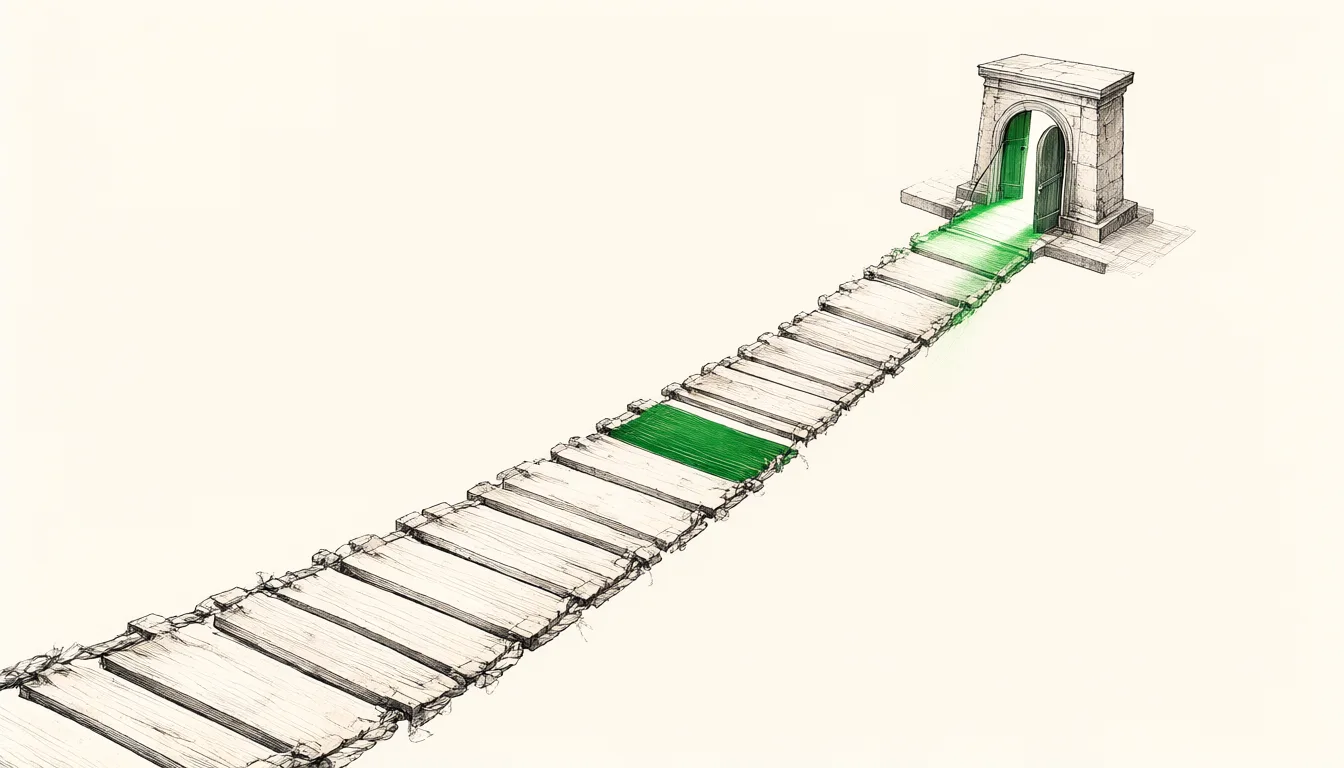
Profitable Raise Ask: Name the Constraint, Show Proof, Size the Step
A profitable company should raise against a named capacity constraint, with proof of demand and a round size tied to that proof.

You are profitable, and you are about to ask for money. The ask should not sound like a plea for runway; it should name the bottleneck and the step the money clears.
Profitable companies raise against a constraint, not a cash gap. The investor needs to see that the limit is real, that demand is ahead of supply, and that the round size matches the next measurable step.
The ask is a constraint, not a wish
Runway is a floor, not a story. A round that only extends cash asks for time. A round tied to a named capacity constraint asks for output.
The constraint is the thing that blocks revenue: a component shortage, a production line, a fulfillment limit, a support ceiling. It must be specific enough that an investor can picture the missing unit of output.
Investors can underwrite a constraint because it creates a clear test. Did the company remove it? Did revenue move? Did the missing unit of output become available? A vague growth ask leaves those questions open.
The on-premises cloud hardware maker Oxide Computer Company secured a $445 million Series D led by Eclipse, announced on Oct. 9, 2026, with USIT, Riot Ventures, and Jane Street participating as existing investors and Atreides Management and AMD Ventures joining as new investors for manufacturing expansion.
The round was tied to a named supply constraint: proceeds would be working capital to secure components, expand manufacturing, and serve new and existing customers because demand exceeded production capacity.
A strong use of proceeds names the constraint and the output it unlocks.
Proof has to carry the round
Profitability is a useful fact, but it is not the whole argument. It tells the investor that the business can survive. It does not tell them why the next step is worth funding.
Operational proof carries more weight: demand that exceeds current supply, a manufacturing ramp that has already happened, or a customer base waiting on capacity.
The proof also has to show that the constraint is not a management artifact. If the company could have cleared it with better scheduling, better staffing, or better vendor management, the ask weakens. The investor needs to see an external, material limit tied to revenue.
Oxide reached profitability earlier in 2026.
That made the raise easier to frame as expansion rather than rescue.
Oxide had scaled manufacturing capacity by 20x over the prior 12 months.
That ramp is the kind of operational proof an investor can verify.
The same proof can be carried into the round as a constraint: the company has already built the capacity, and the next step is using it.
Size the step to the proof
A profitable raise should not be priced like a lottery ticket. The amount should clear the named constraint and capture the demand already in hand.
Round size is a claim. It says, in dollars, how much of the constraint you can clear and how much of the waiting demand you can serve.
A round that is too small leaves the constraint in place. A round that is too large invites the question of whether the company has enough demand to absorb the added capacity. The number should sit where the proof says it can be used.
A board deck can show the work behind the number, not just the ask or the proof.
Pricing your next round is not about maximizing the number on the page. It is about matching the ask to the evidence. When demand exceeds capacity, the ask becomes concrete.
AMD Ventures took a strategic investment position in the round.
USIT led Oxide's previous $200 million raise in February.
New capital into a company that had already shown it could operate at scale makes the next dollar legible.
The ask should survive a quick test
Use three numbers: the constraint, the proof, and the size step. Run the test before you send the deck.
- Proceeds line names the constraint. If the use of proceeds cannot be read as a bottleneck, rewrite it until it can.
- Proof is carried into the round. Demand, capacity, or customer evidence should appear in the ask, not only in the data room.
- Size is a step, not a wish. The amount should match the work needed to clear the constraint and serve the waiting demand.
This article is general information, not investment or legal advice.